
Read about the curriculum offered in the Clinical Cardiac Electrophysiology fellowship program.
Clinical Cardiac Electrophysiology Laboratory
Fellows perform diagnostic and interventional electrophysiology (EP) procedures under the direct supervision of EP faculty. Training emphasizes hands-on procedural experience, technical proficiency, and clinical decision-making.
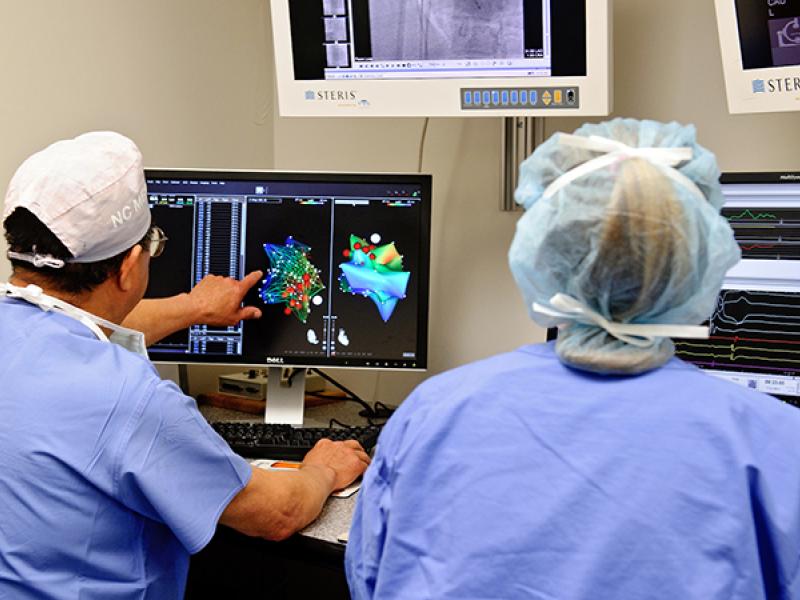
Fellows receive structured instruction in EP laboratory setup, including signal acquisition, amplification, filtering, and interpretation of intracardiac electrograms. Core training includes programmed electrical stimulation, electrophysiologic study design, and interpretation, with emphasis on diagnostic accuracy, indications, risks, and alternatives for both diagnostic studies and catheter ablation.
Procedural training includes vascular access, transseptal catheterization, and simple and complex catheter ablation. Cardiac anatomy is taught in direct correlation with procedural planning and execution.
Fellows are the primary providers for patients undergoing EP procedures. Responsibilities begin with pre-procedural evaluation and informed consent and extend through post-procedural care, including outpatient discharge or inpatient follow-up for 24 hours after the procedure. Fellows write pre- and post-procedure orders, generate procedural reports, communicate findings to the care team, and manage procedural complications under faculty supervision.
Core Competencies: EP Laboratory
Year 1 Focus
- Indications, guidelines, and foundational theory of electrophysiologic studies and ablation
- Catheter insertion and manipulation, vascular access (with and without ultrasound), and transseptal access
- Diagnosis of supraventricular and ventricular arrhythmias using EP tracings
- Ablation of supraventricular and right ventricular arrhythmias
- Post-procedural patient management and complication recognition
Year 2 Focus
- Advanced decision-making, including risk–benefit analysis, cost-effectiveness, and patient preferences
- Fluoroless catheter manipulation and advanced diagnostic algorithms
- Complex left-sided ablation, including atrial fibrillation and ventricular arrhythmias
- Epicardial access and left atrial appendage occlusion (Watchman™) procedures
- Management of immediate and delayed procedural complications
- Teaching and mentoring junior fellows and trainees
ICD and Pacemaker Service
The ICD and pacemaker service provides comprehensive training in device therapy, including patient selection, implantation techniques, and post-implant management.
Fellows assume primary responsibility for patients undergoing device implantation. Under faculty supervision, fellows perform preoperative evaluation, obtain informed consent, implant devices, conduct intraoperative testing, and manage postoperative care. Fellows write all pre- and post-procedure orders and evaluate and manage device-related complications.
Training includes device indications, implantation techniques, lead management, infection recognition, and management of device malfunction. Fellows progress from assisting to serving as primary operator for device implantations.
Core Competencies: ICD and Pacemaker Service
Year 1 Focus
- Indications and guideline-based selection for pacemaker and ICD implantation
- Implantation of single- and dual-chamber pacemakers and ICDs
- Axillary and subclavian vascular access
- Recognition and initial management of procedural complications
- His-bundle pacing for physiologic pacing
Year 2 Focus
- Advanced device selection incorporating patient preference, cost, and risk–benefit analysis
- Biventricular and leadless pacemaker implantation
- Complex venous access, including cephalic cutdown and occluded veins
- Management of pericardial perforation and complex complications
- Left bundle area pacing
- Multidisciplinary planning for complex resynchronization and vascular cases
Cardiac Arrhythmia Clinic
Fellows participate in a minimum of one half-day per week in the outpatient cardiac arrhythmia clinic. Under direct faculty supervision, fellows develop expertise in longitudinal outpatient management of patients with cardiac rhythm disorders.
Responsibilities include obtaining focused histories and physical examinations, reviewing diagnostic data, interrogating pacemakers and ICDs, interpreting ECGs and ambulatory monitoring, and developing individualized diagnostic and treatment plans. Fellows coordinate testing, arrange procedures, follow up results, and communicate findings and recommendations to patients and referring providers.
Core Competencies: Arrhythmia Clinic
Year 1 Focus
- Diagnostic evaluation of arrhythmias using ECGs, ambulatory monitoring, and exercise testing
- Development of evidence-based management plans
- Pre-procedural risk assessment and patient counseling
- Timely documentation and communication with care teams
Year 2 Focus
- Independent outpatient evaluation and comprehensive management planning
- Advanced consultative communication with patients, families, and referring clinicians
- Triage of urgent arrhythmia referrals
- Integration of end-of-life preferences and shared decision-making
- Identification of care gaps and quality improvement opportunities