
Dear Colleagues,
It is always exciting to highlight one of the jewels we have here at MU Health Care and the University of Missouri School of Medicine.
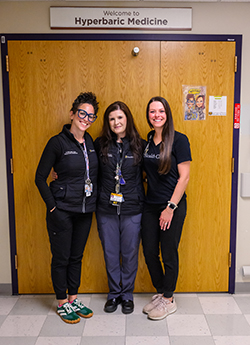
One that recently caught my eye is the hyperbaric oxygen therapy (HBOT) unit. Housed on the third floor of University Hospital and directed by Quinn Johnson, MD, chair of the Department of Anesthesiology, the unit is operated by three registered respiratory technicians (RRTs): Jackie Virgilio (lead), Rebecca Zacharias and Miranda Mell.
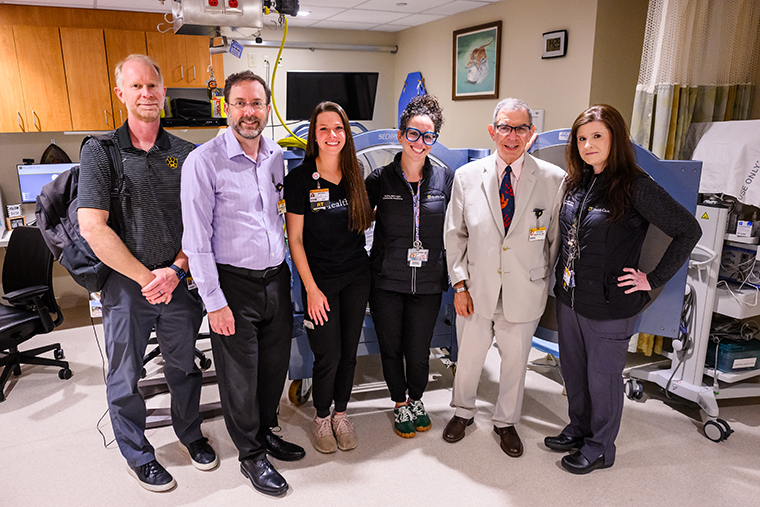
HBOT is highly effective in treating a number of conditions, including carbon monoxide poisoning and “the bends” — decompression sickness from rising too quickly from underwater diving.
In our academic health system, and in general, HBOT’s most common application is the acceleration of wound healing. Diabetics with slow-to-heal ulcers, car accident victims with crushed limbs and cancer patients whose tissues have been damaged by radiation are frequently HBOT candidates.
Performed in an acrylic chamber that fills with pure oxygen at 2-3 times atmospheric pressure, HBOT jump-starts the body’s natural repair mechanisms. By forcing hyper-oxygenated blood into damaged tissues, it stimulates blood vessel growth, boosts collagen production, reduces inflammation, fights infections and triggers stem cell release.
Two or three patients are treated per day in our HBOT chamber. The patient is placed on a gurney, which slides into the chamber. The door is shut, and the oxygen starts flowing.
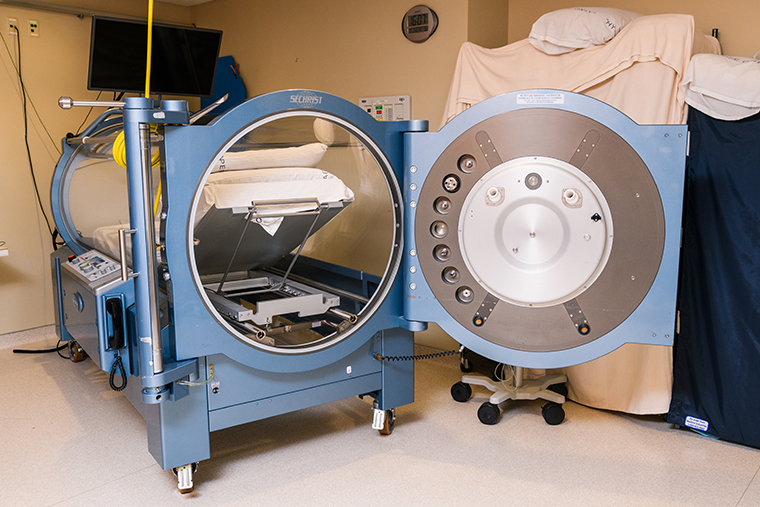
Treatment typically lasts 90 minutes; with set up time, the experience takes about 2 hours per patient. A course of treatment can range from a single emergency session to multiple daily sessions for chronic conditions.
Throughout the procedure, the patient is monitored with a piece of equipment known as a transcutaneous oximetry reader (TCOM). The TCOM uses a heated electrode to dilate capillaries and measures how much oxygen diffuses into surrounding tissues. It’s also used before HBOT to determine whether the therapy will be of benefit.
Here at MU Health Care and the Mizzou School of Medicine, we are fortunate to have not only amazing equipment, but talented teams to operate it. The HBOT is one of many gems that reflect our commitment to saving and improving lives across central Missouri.
Sincerely,

Rick Barohn, MD
Executive Vice Chancellor for Health Affairs and Hugh E. and Sarah D. Stephenson Dean, School of Medicine
rbarohn@health.missouri.edu