
By Mary Caitlyn Rodriguez, rodriguezmc@health.missouri.edu l MU Health Care
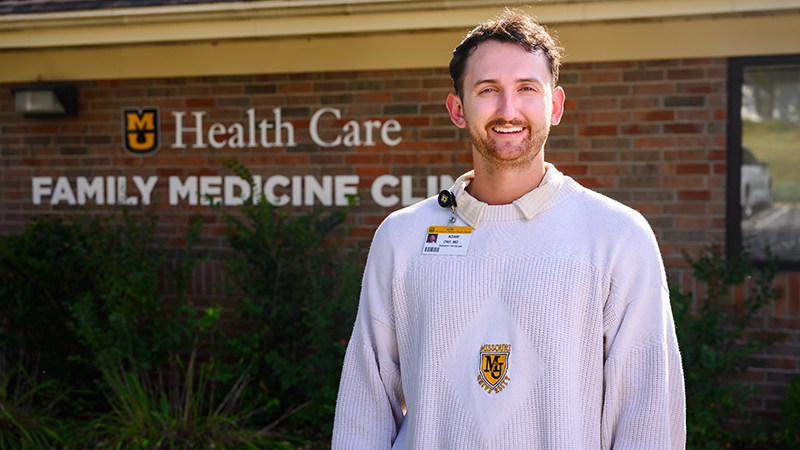
Growing up in Troy, Missouri, Adam Orf didn't have to look far to understand the impact a family physician can have.
"Within my rural town, family medicine was always the backbone of our health care system," Adam said. "In rural communities, the family medicine doctor is kind of a gateway for everything. It's a big responsibility, but it's also very cool. What an honor to stand in that role for your patients."
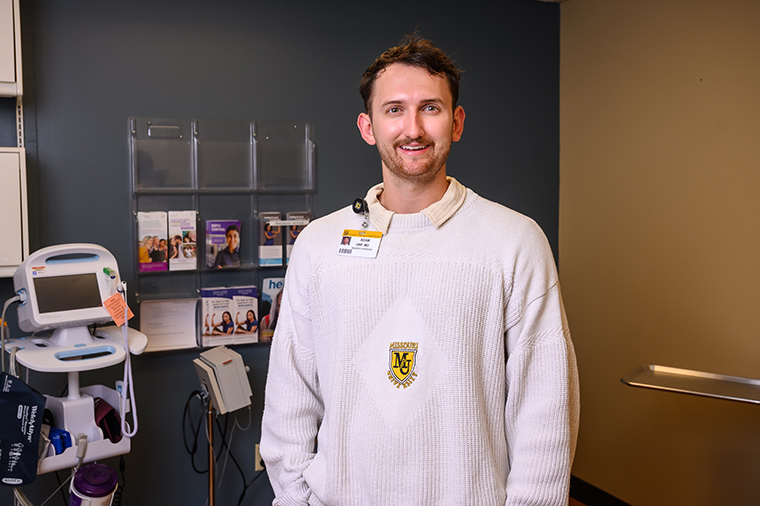
This summer, Adam, a Mizzou School of Medicine graduate, took the next step toward filling that role as a resident at MU Health Care's Fayette Family Medicine Clinic.
Medicine wasn't a family tradition. No one in Adam's family worked in health care. Instead, his interest grew through experiences that introduced him to the impact physicians can have on a community.
As a high school student, he participated in a summer immersion program at his local hospital, shadowing physicians, nurses, therapists and dietitians. The experience offered him his first behind-the-scenes look at rural health care and planted the seed for a career in medicine.
That interest became a calling during his freshman year at Mizzou, when he joined a medical mission trip to underserved communities in the Dominican Republic.
"That was really eye-opening," Adam said. "From that moment, I knew I wanted to do medicine, specifically serving underserved communities."
Finding Purpose in Family Medicine
Although Adam entered medical school with an open mind about specialty choice, family medicine always stood out.
His conviction grew stronger during his third year in the School of Medicine's Rural Scholars Program, where he completed a yearlong clinical experience in St. Joseph, Missouri. Unlike traditional block rotations, the program allowed him to follow patients over time while learning across multiple specialties simultaneously. During his fourth year, Adam continued his clinical training with a rotation at MU Health Care's Fayette Family Medicine Clinic.
Each of those experiences gave him a different perspective on patient care.
One of the patients he followed was a child from birth through the first year of life. Along the way, he attended well-child visits, watched developmental milestones unfold and got to know the child's family.
"It was really cool to see the kid grow up a little bit and hit those milestones," Adam said. "It was also nice to get to know the parents and listen to their concerns.”
He also remembers helping care for a patient whose diagnosis required treatment from specialists in Kansas City. After specialty appointments, Adam helped explain what the care team discussed, reinforcing the connection between the patient and their primary care team.
"I love the idea of being able to follow people for longer periods of time," he said. "You get to impact their health in such a unique way."
That long-term relationship also creates opportunities to prevent illness before it starts, something Adam sees as one of primary care's greatest strengths.
"How do we improve the conditions people have today? Or, if we can't improve them, how do we keep them from getting worse?" he said. "And how do we prevent future health problems? That's a really important part of health care."
Choosing to Stay at MU Health Care
When residency Match Day arrived, staying at MU Health Care felt like the right choice.
After earning both his undergraduate and medical degrees at Mizzou, Adam had built strong relationships with faculty, residents and mentors. He also knew the family medicine program's reputation for broad clinical training aligned with the physician he hoped to become.
"They have a strong reputation in family medicine, great mentorship and they really do a good job of training you in a lot of different things," Adam said. "You can be as diverse or as focused as you want when you finish."
One of the biggest draws was the chance to return to Fayette, where he had discovered a community and care model that felt like the right fit during medical school.
"I loved my time at Fayette," he said. "I wanted to go from being a student there to becoming somebody's primary care doctor."
Training within an academic health system also means learning alongside specialists, caring for patients in a variety of settings and building skills that will prepare him for practice in a rural community.
"I feel really reassured that we have outstanding faculty and so many people willing to teach," Adam said. "You get to see a wide variety of patients, build your skills and become better equipped to take care of people wherever you practice."
Looking Ahead
Only weeks into residency, Adam has already cared for patients in the emergency department, outpatient clinic and hospital. Each experience has reinforced what first drew him to family medicine: no two days are the same, and every patient brings an opportunity to build trust.
While he isn't certain which Missouri community he'll eventually call home, he knows the kind of physician he wants to become.
"I know I want to do rural medicine, and I know I want to stay in Missouri," Adam said. "I want to contribute to those communities not just as a physician, but as a community member, because rural communities can sometimes get forgotten about."
That's what drew Adam to family medicine in the first place—and it's what continues to guide him during his residency at MU Health Care: building relationships, earning trust and helping ensure patients can find high-quality care close to home.