
Harriet Omenge, a graduate student in the University of Missouri School of Medicine Translational Biosciences PhD program, recently earned national recognition for her research on endometriosis pain.
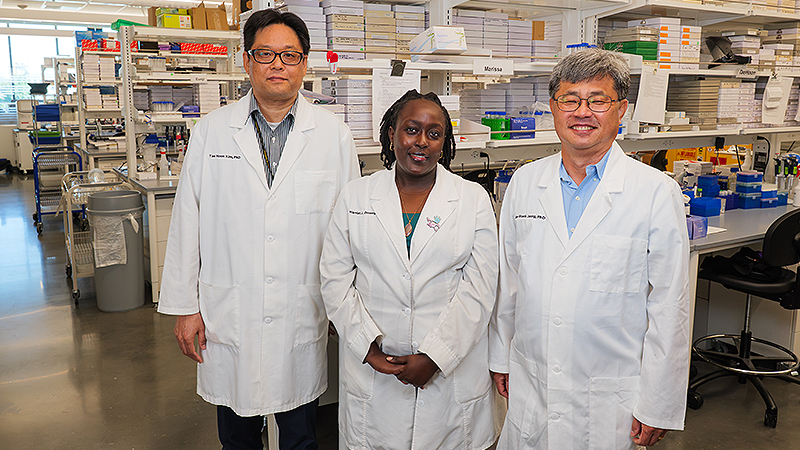
Her journal entry, Endometriosis-associated pain: mechanism, neuroimmune signature, and translational precision strategies, was developed in the Roy Blunt NextGen Precision Health Building under the supervision of Tae Hoon Kim, PhD, assistant professor of Obstetrics, Gynecology and Women’s Health, and Jae-Wook Jeong, PhD, professor of Obstetrics, Gynecology and Women’s Health.
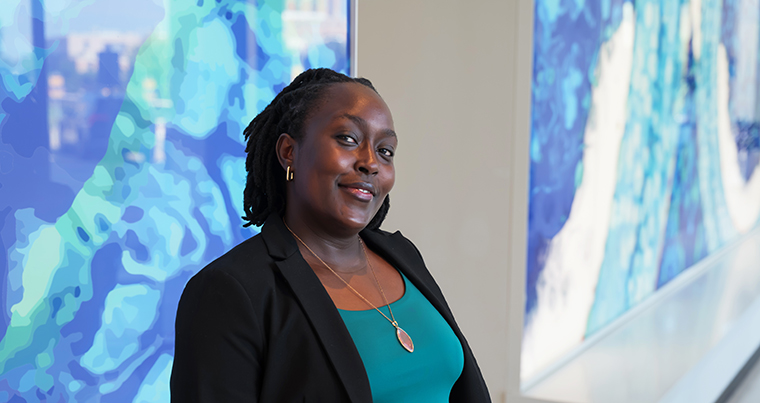
In August, Omenge’s research was a featured article in Endocrine Reviews, one of the highest-impact journals in Endocrinology. In her research team’s review, they advocated for a shift away from traditional approaches for treating endometriosis pain. Instead, they called for the use of biomarkers to identify a patient’s unique molecular “pain fingerprints” to allow for more tailored prescriptions.
“Endometriosis affects roughly one-in-10 women of reproductive age worldwide, yet it remains widely misunderstood-often taking years to properly diagnose,” said Omenge. “Endometriosis pain is driven by a complex combination of hormone imbalances, chronic inflammation and hyper-sensitive nerves. Treatment requires looking beyond just physical lesions, and advances in personalized medicine and targeted therapies offers hope for patients.”
To help expand her knowledge of the research topic on-hand, Omenge was advised to write and submit a review paper. Throughout the development of the manuscript, Jeong and Kim provided guidance on the scientific context, scope and organization of the paper. She also received recommendations from Kyeong A. So, a clinician and visiting scholar in the NextGen laboratory.
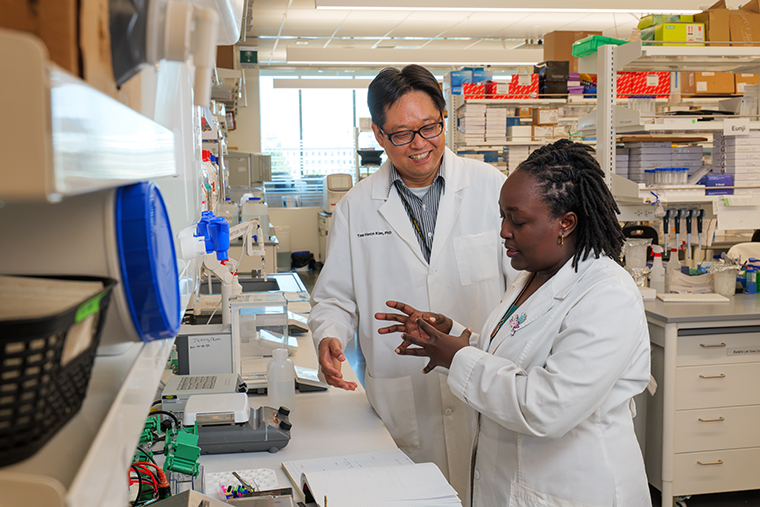
Serving as Omenge’s primary mentor, Kim provided overall guidance and oversight of all research activities. While work in the laboratory is a collaborative effort, Kim encourages student investigators like Omenge to go beyond the initial guidance and contribute her own ideas.
“She not only followed the recommended framework we provided but also identified opportunities to improve the overall flow and coherence of the story,” said Kim. “Given that the paper addressed multiple emerging and complex aspects of endometriosis-associated pain, her ability to integrate diverse concepts into a clear and compelling narrative was particularly impressive.”
For Jeong, his favorite part of research collaboration with students is watching them develop from people who are learning how to conduct research into scientists who begin generating their own questions and ideas.
“One of the strengths of an academic medical center like Mizzou is that students can participate directly in research that connects fundamental biology with important clinical problems,” said Jeong. “Working closely with faculty and staff allows students to see how science develops, how we formulate a question, evaluate evidence, encounter unexpected results, revise our thinking and communicate our findings. It results in valuable experiences that are difficult to reproduce in the classroom alone.”

Highlighting the promise of personalized health care and the impact of large-scale interdisciplinary collaboration, the NextGen Precision Health initiative is bringing together innovators from across the University of Missouri and the UM System’s three other research universities in pursuit of life-changing precision health advancements. It’s a collaborative effort to leverage the research strengths of Mizzou toward a better future for the health of Missourians and beyond. The Roy Blunt NextGen Precision Health building at MU anchors the overall initiative and expands collaboration between researchers, clinicians and industry partners in the state-of-the-art research facility.
Related News
School of Medicine hosts 2026 Physicians Alumni Weekend
2025-26 newly promoted faculty; milestone anniversaries