

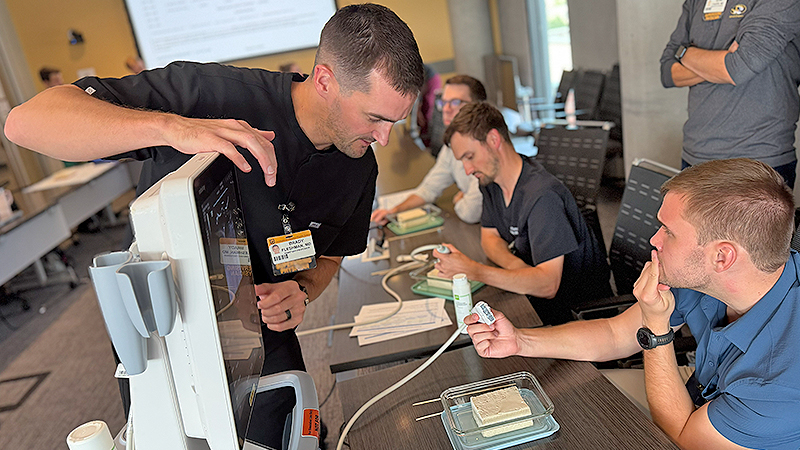
The University of Missouri School of Medicine Department of Family and Community Medicine was recently named the Central Region Hub for the PRIME POCUS Learning Network.
Point-of-care ultrasonography (POCUS) is limited diagnostic ultrasonography that is performed and interpreted by the treating clinician as a bedside test. The POCUS Research, Innovation and Medical Education Network (PRIME) was launched with support from a grant from the American Board of Family Medicine Foundation. The network is housed within the Department of Family Medicine at the University of North Carolina School of Medicine.
As the network’s Central Region Hub, Mizzou’s Department of Family and Community Medicine will help expand family medicine POCUS education and scholarship across the central United States while contributing to PRIME’s broader mission to build national infrastructure for primary care ultrasound education and research.
The Central Region Hub is directed by Michael Ulen, MD, assistant professor of Family and Community Medicine. Nicholas LeFevre, MD, associate professor of Family and Community Medicine and medical director for POCUS, will serve as the hub advisor and research director for PRIME.

“Technology has advanced to the point that many ultrasound exams can now be done with handheld devices, miniaturized to the point that they fit in a physician’s pocket,” said LeFevre. “POCUS is becoming more common across medical specialties and is one instrumental tool helping clinicians answer important questions and improve patient care.”
Through PRIME, Mizzou’s Department of Family and Community Medicine will host regional POCUS educational workshops, participate in collaborative research efforts, contribute to shared educational content and support the development of scalable models for clinical POCUS implementation in family medicine.
Training and innovation will be supported through partnership with the Mizzou School of Medicine Russell D. and Mary B. Shelden Clinical Simulation Center, a world-class simulation environment with deep experience supporting POCUS education through multiple simulators, an ultrasound standardized patient program, robust handheld and cart-based ultrasound technology, and locally developed ultrasound training phantoms.
“It’s a privilege for the Shelden Clinical Simulation Center to collaborate with the Department of Family and Community Medicine to advance POCUS training through innovative, hands-on education,” said Dena Higbee, senior director of simulation and educational technology innovations. “This partnership also provides an exciting opportunity to further develop and refine sophisticated ultrasound training models that can be replicated and distributed across all training hubs, expanding access to consistent, high-quality POCUS education.”
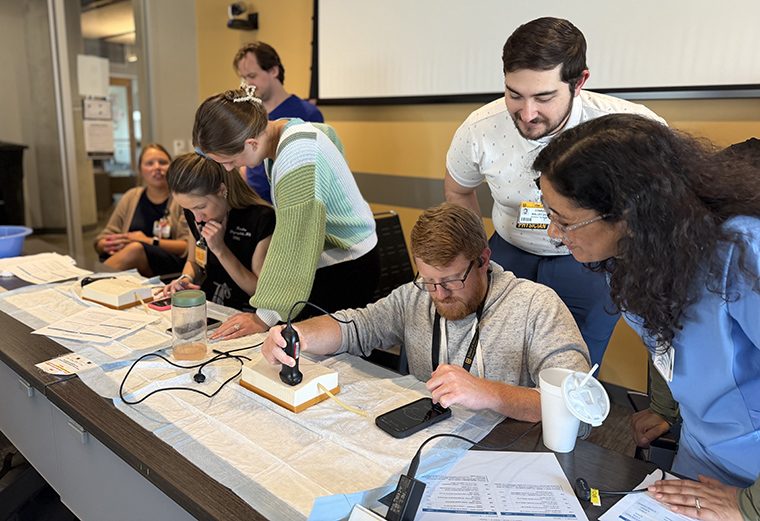
Since 2022, Mizzou’s Department of Family Medicine has substantially invested in POCUS, including the deployment of handheld ultrasound devices across its family medicine clinical sites and inpatient services, the development of encounter-based POCUS workflows, and the implementation of a department-wide faculty training and quality assurance program.
POCUS may be particularly valuable in rural and limited-access settings, where access to diagnostic imaging may be constrained. The family medicine residency’s POCUS curriculum aims to equip graduates with these skills as they enter primary care practice, including in rural and underserved communities across Missouri and beyond. PRIME will help broaden that educational mission to physicians across the region.
Related News

Dr. Ai-Ling Lin earns 2026 Distinguished Investigator Award


Dr. Young-Walker earns 2026 AAMC Presidential Award